Final-year medical student training in neurosurgery, shaped by clinical rotations across Athens, Zürich, and Berlin — and by a lasting curiosity about the brain as the biological seat of thought, memory, and consciousness.
Since 2020, Alexandros has trained at the Medical School of the National and Kapodistrian University of Athens, drawn to neurosurgery by a lifelong fascination with the most complex organ in the human body — and by how much of the brain, and of consciousness itself, remains unexplained.
That curiosity has taken him from the microsurgery laboratories of Athens to clinical rotations at Charité – Universitätsmedizin Berlin and two leading neurosurgical departments in Zürich, alongside ongoing meta-analytic research into craniopharyngioma and meningioma surgical outcomes at Attikon University Hospital.
General areas of interest at this early stage of training — before choosing a subspecialty within neurosurgery.
A deep, ongoing engagement with the brain — from microsurgical technique to the neuroanatomy and pathophysiology underlying it.
Contributing to systematic reviews and meta-analyses that compare surgical approaches and strengthen the evidence behind clinical decisions.
Treating the whole person, not only the diagnosis — combining clinical precision with attentiveness to a patient's broader wellbeing.
Approaching difficult conversations and vulnerable moments with empathy, patience, and honest communication.
Values reflected consistently in clinical training and in the assessment of mentors and supervisors.
Placing patients' comfort and dignity at the center of every decision — carried from hospital wards in Athens to volunteer medical missions across Greece.
Approaching every task, however small, with rigor and modesty — the same standard applied on rotations in Zürich and Berlin as in the lab in Athens.
A lasting fascination with what remains unknown about the brain and human consciousness, driving every research question asked.
Analyzing clinical and scientific problems methodically, and testing assumptions rather than accepting them at face value.
Steady, consistent effort recognized across clinical rotations, research projects, and years of academic training.
Strong, team-oriented work across multidisciplinary clinical and academic settings, built on clear communication and mutual respect.
Highest grade in Physiology, National and Kapodistrian University of Athens.
Awarded for the highest national exam score in high school.
Highlights from clinical training, research, and recognition. The full record — including every publication, conference, and role — is available in the CV.
Universitätsspital Zürich — hands-on clinical rotation in one of Switzerland's leading academic neurosurgery departments.
Klinik Hirslanden, Zürich — neurosurgical rotation under Prof. Dr. Reisch.
Charité – Universitätsmedizin Berlin, Campus Benjamin Franklin — practical medical training in neurosurgery under Prof. Dr. med. P. Vajkoczy.
Klinik Hirslanden, Zürich — neurosurgical rotation under Prof. Dr. Fandino.
National and Kapodistrian University of Athens — Doctor of Medicine (MD), summa cum laude, expected graduation 2027.
Looking for the complete record?Full education, clinical experience, publications, conferences, and affiliations are documented in the CV.
Download Full CV ↗Perdikakis, M., Papadimitrakis, D., Papadopoulos, A., Sinou, N., Sinou, N. & Filippou, D. https://doi.org/10.5281/zenodo.19387670
Perdikakis M, Nikolakakis I, Papadopoulos A, Diaconu CC, Karamanou M. Arch Balk Med Union. 2025;60(3):398–402.
Brief posts on cases, ideas, and questions encountered along the way — not formal articles, just short thoughts worth keeping.
Most advice on "studying better" comes down to the same thing: more hours, more summaries, more discipline. In my own experience through medical school, that's rarely the decisive lever. The four principles that made the biggest difference for me are simpler, but less obvious.
A lot is decided before you even open a book. Approaching material with the expectation "this is going to be terrible" burns energy on resistance that should go toward actual learning. A positive baseline expectation — not naive confidence, but the plain assumption "this is learnable, I'll find a way through it" — changes how easily you can concentrate and how you respond to setbacks. Expectation isn't a side note to preparation; it's where preparation starts.
The so-called Pareto principle states that roughly 80% of results come from just 20% of the effort — the rest contributes comparatively little. Applied to studying, this means: a small fraction of the material — the core concepts that keep reappearing in questions, case studies, and past exams — accounts for most of your exam results. The remaining 80% of the material, things like detailed knowledge, edge cases, and footnotes, only contributes the last 20% to your grade.
The practical problem is that most students treat every page with equal thoroughness. They spend just as much time on a rarely-tested side note as on a core concept that shows up in nearly every exam. The result is wasted time on low-yield material, while the 20% that actually matters doesn't get the repetition it deserves.
Before you start studying, it's worth doing an honest sort: which topics keep reappearing in past exams, lecture emphasis, and exam questions? Which concepts, once you truly understand them, make other questions solvable almost automatically? Study these core topics first and most thoroughly — the drive for completeness can wait until that foundation is solid.
Unlimited time sounds relaxing, but it usually leads to unfocused, drifting work. A timer — whether 25, 45, or 90 minutes — turns a vague intention into a concrete, bounded unit of work. It creates artificial but effective pressure that makes procrastination harder, and it makes breaks legitimate: when the time is up, you're genuinely allowed to stop. That clear boundary is often the only difference between an hour of "studying" and an hour of actual focus.
Jumping between lecture slides, your phone, and a second task feels productive, but it demonstrably isn't. Every switch costs time and mental energy as your brain works to re-enter the previous train of thought. Doing one thing at a time, with your phone out of sight, produces more understanding in less time than juggling several topics in parallel.
None of these four points is complicated — which is exactly why they're easy to underestimate. Deliberately set positive expectations, focus on the decisive 20%, work in clear timer-bound blocks, and do one thing at a time. These aren't tricks; they're the foundation that makes every other study strategy actually work.
Die meisten Ratschläge zum "besser lernen" laufen auf dasselbe hinaus: mehr Stunden, mehr Zusammenfassungen, mehr Disziplin. Aus eigener Erfahrung im Medizinstudium kann ich sagen, dass das selten der entscheidende Hebel ist. Die vier Prinzipien, die für mich den größten Unterschied gemacht haben, sind einfacher, aber ungewohnter.
Bevor du überhaupt ein Buch aufschlägst, entscheidet sich viel in deinem Kopf. Wer mit der Erwartung "Das wird furchtbar schwer" an einen Stoff herangeht, verbraucht Energie für Widerstand, die eigentlich zum Lernen gebraucht wird. Eine positive Grunderwartung – nicht naive Zuversicht, sondern die schlichte Annahme "Das ist lernbar, ich finde einen Weg" – verändert, wie leicht dir Konzentration fällt und wie du mit Rückschlägen umgehst. Erwartung ist kein Nebenschauplatz der Vorbereitung, sie ist ihr Ausgangspunkt.
Das sogenannte Pareto-Prinzip besagt: Ungefähr 80 % der Ergebnisse entstehen durch nur 20 % des Aufwands – der Rest bringt vergleichsweise wenig. Auf das Lernen übertragen heißt das: Ein kleiner Teil des Stoffes – die zentralen Konzepte, die immer wieder in Fragen, Fallbeispielen und Altklausuren auftauchen – erklärt den größten Teil deiner Prüfungsergebnisse. Die restlichen 80 % des Stoffes, etwa Detailwissen, Sonderfälle und Fußnoten, tragen nur die letzten 20 % zur Note bei.
Das praktische Problem: Die meisten Studierenden behandeln jede Seite gleich gründlich. Sie verbringen genauso viel Zeit mit einer selten geprüften Randnotiz wie mit einem Kernkonzept, das in fast jeder Prüfung wieder auftaucht. Das Ergebnis ist Zeitverlust an Stellen mit geringem Ertrag, während die wirklich entscheidenden 20 % nicht die Wiederholungen bekommen, die sie verdienen.
Bevor du lernst, lohnt sich deshalb eine ehrliche Sortierung: Welche Themen tauchen in Altklausuren, Vorlesungsschwerpunkten und Prüfungsfragen immer wieder auf? Welche Konzepte, wenn du sie wirklich verstehst, machen automatisch auch andere Fragen lösbar? Diese Kernthemen zuerst und am gründlichsten lernen – der Anspruch auf Vollständigkeit darf warten, bis dieses Fundament sitzt.
Unbegrenzte Zeit klingt entspannend, führt aber meist zu unkonzentriertem Vor-sich-hin-Arbeiten. Ein Timer – ob 25, 45 oder 90 Minuten – verwandelt eine vage Absicht in eine konkrete, abgeschlossene Einheit. Er schafft künstlichen, aber wirksamen Druck, der Prokrastination erschwert, und er macht Pausen legitim: Wenn die Zeit um ist, darfst du wirklich aufhören. Diese klare Grenze ist oft der einzige Unterschied zwischen einer Stunde "Lernen" und einer Stunde tatsächlicher Konzentration.
Zwischen Vorlesungsfolien, Handy und einer zweiten Aufgabe hin- und herzuspringen fühlt sich produktiv an, ist es aber nachweislich nicht. Jeder Wechsel kostet Zeit und mentale Energie, bis das Gehirn wieder in den vorherigen Gedankengang zurückfindet. Eine Aufgabe nach der anderen, mit dem Handy außer Sichtweite, bringt in der Praxis mehr Verständnis in weniger Zeit als paralleles Jonglieren mehrerer Themen.
Keiner dieser vier Punkte ist kompliziert – gerade das macht sie leicht zu unterschätzen. Erwartungen bewusst positiv setzen, sich auf die entscheidenden 20 % konzentrieren, mit Timer in klaren Blöcken arbeiten und jeweils nur eine Sache tun: Das sind keine Tricks, sondern die Grundlage, auf der jede weitere Lernstrategie erst wirkt.
Imagine two hemispheres sharing the same skull, but having lost their main channel of communication. This is what happens in so-called "split-brain" patients — people in whom the corpus callosum, the thick bridge of nerve fibers connecting the left and right hemispheres, has been surgically severed.
This procedure, known as a callosotomy, was never designed to study consciousness. Since the 1940s, it has been used as a last-resort treatment for patients with severe, drug-resistant epilepsy, when seizures were jumping from one hemisphere to the other through the corpus callosum. By cutting this "bridge," doctors were often able to dramatically reduce the frequency of seizures.
What followed was remarkable: most patients appeared, in everyday life, completely normal. They spoke, walked, recognized their families. But when researchers — first among them Roger Sperry, Michael Gazzaniga, and Joseph Bogen in the early 1960s — began examining them with carefully designed experiments, they uncovered something entirely different.
In a healthy brain, information reaching one hemisphere is automatically shared with the other through the corpus callosum. Without that connection, each hemisphere begins to "see" the world on its own.
The classic experiment is simple but revealing: show a split-brain patient a word only in the left visual field (processed by the right hemisphere, which usually doesn't control speech), and the patient can't say what they saw. And yet, their left hand — controlled by the right hemisphere — can correctly pick out the matching object among others, by touch, without the patient knowing "why" they did it.
It's as if two intelligent "agents" exist within the same skull, cooperating to run a single body, communicating now only through very narrow, indirect channels — the way two people sharing the same hands might cooperate, yet can no longer speak to one another directly.
In rare cases, this disconnection leads to something even more unsettling: alien hand syndrome. The patient feels one of their hands acting on its own — unbuttoning a shirt the other hand just buttoned, or grabbing an object without conscious intention. This isn't a hallucination; it's the visible result of two hemispheres acting, quite literally, independently.
The first generation of researchers spoke of a "split consciousness" — as if the surgery essentially created two separate "selves" within the same skull. More recent studies, however, paint a more complex picture: perception may be divided by hemisphere without the patient experiencing themselves as two people. Even sleep is affected — EEG studies have shown that, without the corpus callosum, the slow waves of sleep struggle to travel from one hemisphere to the other.
Six decades after the first callosotomies, split-brain patients remain one of the most important "natural experiments" for understanding consciousness. They remind us that the feeling of a single, coherent "self" isn't a given — it may, instead, be the result of a fragile, uninterrupted conversation between parts of the brain that, under different circumstances, could very well function apart.
Stellen Sie sich zwei Hemisphären vor, die sich denselben Schädel teilen, aber ihren wichtigsten Kommunikationskanal verloren haben. Genau das geschieht bei sogenannten „Split-Brain"-Patienten — Menschen, bei denen das Corpus callosum, das dicke Bündel von Nervenfasern, das die linke mit der rechten Hemisphäre verbindet, chirurgisch durchtrennt wurde.
Dieser Eingriff, bekannt als Kallosotomie, wurde nie entwickelt, um das Bewusstsein zu erforschen. Seit den 1940er-Jahren wird er als letzte Behandlungsoption bei Patienten mit therapieresistenter Epilepsie eingesetzt, wenn epileptische Anfälle über das Corpus callosum von einer Hemisphäre zur anderen übersprangen. Indem Ärzte diese „Brücke" durchtrennten, gelang es ihnen oft, die Anfallshäufigkeit drastisch zu reduzieren.
Bemerkenswert war das, was folgte: Die meisten Patienten wirkten im Alltag völlig normal. Sie sprachen, gingen, erkannten ihre Familien wieder. Doch als Forscher — allen voran Roger Sperry, Michael Gazzaniga und Joseph Bogen in den frühen 1960er-Jahren — begannen, sie mit sorgfältig konzipierten Experimenten zu untersuchen, entdeckten sie etwas völlig anderes.
Im gesunden Gehirn werden Informationen, die eine Hemisphäre erreichen, automatisch über das Corpus callosum mit der anderen geteilt. Ohne diese Verbindung beginnt jede Hemisphäre, die Welt für sich allein „zu sehen".
Das klassische Experiment ist einfach, aber aufschlussreich: Zeigt man einem Split-Brain-Patienten ein Wort nur im linken Gesichtsfeld (das von der rechten Hemisphäre verarbeitet wird, die normalerweise nicht die Sprache steuert), kann der Patient nicht sagen, was er gesehen hat. Und doch kann seine linke Hand — gesteuert von der rechten Hemisphäre — durch Ertasten korrekt das passende Objekt unter anderen auswählen, ohne dass der Patient weiß, „warum" er das getan hat.
Es ist, als existierten im selben Schädel zwei intelligente „Akteure", die zusammenarbeiten, um einen einzigen Körper zu steuern, und nun nur noch über sehr schmale, indirekte Kanäle kommunizieren — so wie zwei Menschen, die sich dieselben Hände teilen, aber nicht mehr direkt miteinander sprechen können.
In seltenen Fällen führt diese Trennung zu etwas noch Beunruhigenderem: dem Alien-Hand-Syndrom. Der Patient spürt, wie eine seiner Hände von selbst handelt — einen Knopf öffnet, den die andere Hand gerade geschlossen hat, oder nach einem Gegenstand greift, ohne bewusste Absicht. Dies ist keine Halluzination; es ist das sichtbare Ergebnis zweier Hemisphären, die buchstäblich unabhängig voneinander handeln.
Die erste Forschergeneration sprach von einem „gespaltenen Bewusstsein" — als hätte der Eingriff im Grunde zwei getrennte „Selbste" im selben Schädel geschaffen. Neuere Studien zeichnen jedoch ein komplexeres Bild: Die Wahrnehmung kann sich zwar nach Hemisphäre aufteilen, ohne dass der Patient sich selbst als zwei Personen erlebt. Sogar der Schlaf ist betroffen — EEG-Studien haben gezeigt, dass sich die langsamen Schlafwellen ohne das Corpus callosum nur schwer von einer Hemisphäre zur anderen ausbreiten.
Sechs Jahrzehnte nach den ersten Kallosotomien bleiben Split-Brain-Patienten eines der wichtigsten „natürlichen Experimente" zum Verständnis des Bewusstseins. Sie erinnern uns daran, dass das Gefühl eines einzigen, zusammenhängenden „Selbst" keineswegs selbstverständlich ist — es ist vielleicht das Ergebnis eines fragilen, ununterbrochenen Gesprächs zwischen Teilen des Gehirns, die unter anderen Umständen durchaus auch getrennt funktionieren könnten.
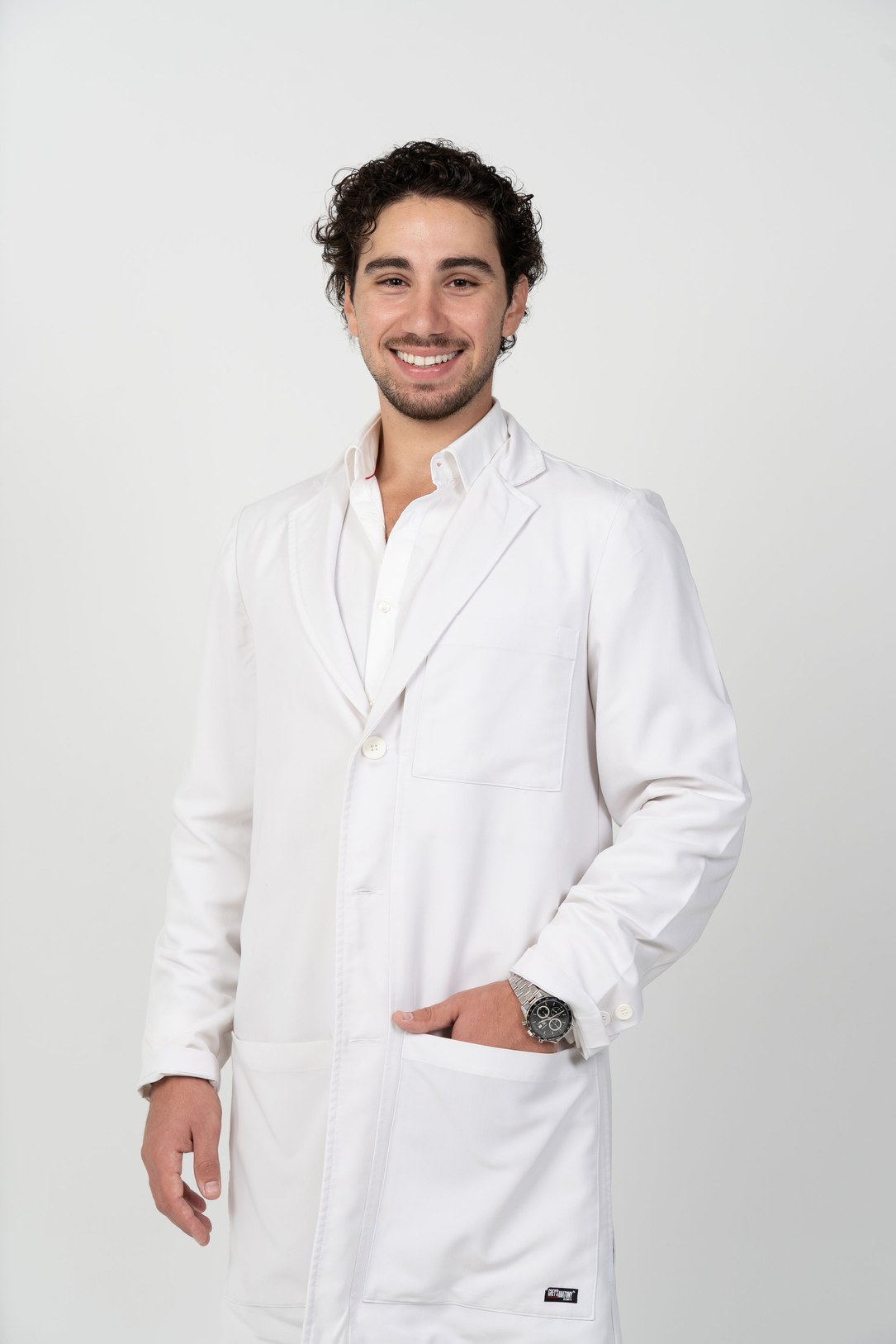
A few photos alongside the portrait — from the clinic, conferences, and everyday moments along the way.